What Pottery Tools Do Beginners Actually Need?
· Updated · 4 min read
Every studio has a jar of tools by the wheel, and a lot of what’s in it is duplicates. You can start with six, whether you throw or build by hand.
The six
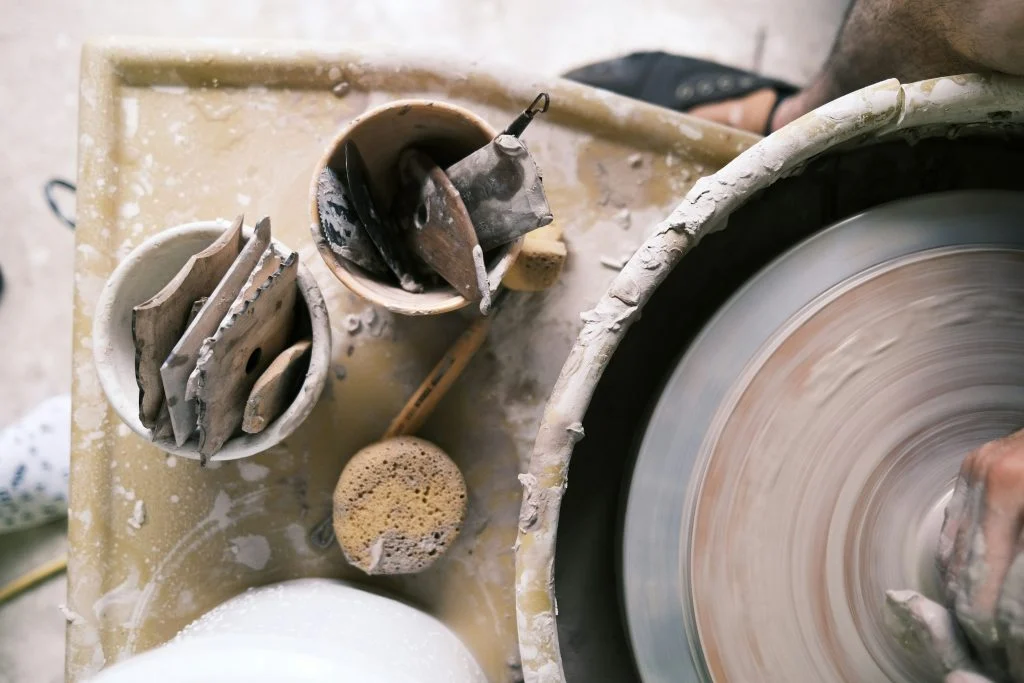
1. A cutting wire
Two handles and a length of wire. It cuts clay off the block, slices through a lump when you wedge, and cuts a finished pot off the wheel. Keep it taut and pull it toward you, flat against the wheel. A twisted steel wire leaves a swirl on the base, and a plain wire with rubber grips cuts flat. More in clay cutting wires.
2. A sponge
Sponges handle water. On the wheel they wet the clay while you center and pull, lift water out of the bottom of a pot and soften rims. Off the wheel they smooth seams and clean up greenware. A small finishing sponge plus a sponge on a stick for deep, narrow pots covers nearly everything. See pottery sponges.
3. A needle tool
A long, sharp point in a handle. It trims uneven rims, scores clay before you join it, checks how thick a floor is, pops air bubbles and marks lines. You’ll probably reach for it more than anything else. Look in detail and needle tools.
4. A wooden rib
A flat, shaped piece of wood. Pressed against a spinning pot it compresses the clay, removes slip and refines the profile. Curved edges shape bowls, and straight edges make cleaner cylinders. Handbuilders use them to smooth and compress slabs. A small set like the 5 piece wooden rib and modeling knife set gives you a few edge shapes at once. More in wooden ribs.
5. A metal scraper or kidney
A thin, flexible steel rib. It scrapes off surface slip, smooths leather-hard clay and gives curves a crisper edge than wood does. Serrated edges add texture and even out lumpy handbuilt walls. Look in metal and profile ribs.
6. A loop or ribbon tool
A wire loop on a handle that shaves clay off in thin ribbons. On the wheel it’s the trimming tool, used to carve a foot ring and take weight off the bottom of a leather-hard pot. Handbuilders use it to hollow out solid forms. See loop and ribbon tools, and our guide to trimming pottery.
| Kit | What’s in it | Pick it if |
|---|---|---|
| 8 piece basic kit | Wooden rib, modeling knife, needle tool, double-ended wire loop, ribbon tool, sponge, wire cutter, steel scraper | You want one of each essential and nothing extra |
| 17 piece kit with pouch | The same essentials plus five wooden modeling knives and points, a rake tool, two ball styluses, a second loop tool and a zip pouch | You’ll handbuild or carve details, or want a pouch to carry them in |
| 17 piece kit, 8 piece style | A smaller set from the same kit | You want the essentials for less |
Starter tools we recommend
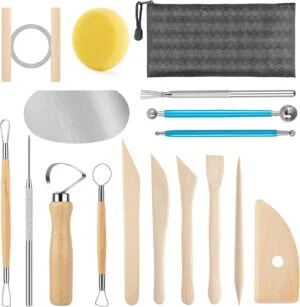
Use it for: Best value: the six essentials plus extras, in a zip pouch
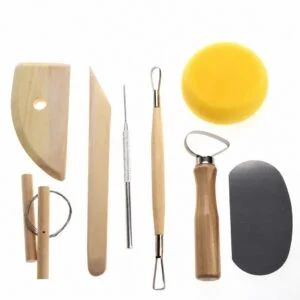
Use it for: One of each essential and nothing extra
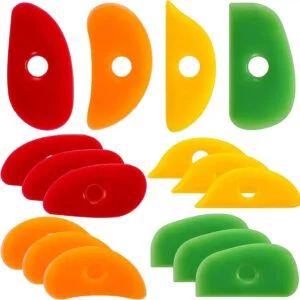
Use it for: Compressing floors so first pots don't crack
Skip it if: your kit already came with a rubber rib
Wheel or handbuilding?
The list barely changes. Throwers lean on the sponge, wooden rib, wire and loop tool, and soon want bats so wide pieces can come off the wheel untouched. Handbuilders use the needle tool, ribs and scraper constantly, then add a rolling pin, slab rolling guides and a few cutters. If you don’t know which you’ll prefer, the six work for both. More on handbuilding with slabs.
What to add next
- Calipers, to measure a lid against the gallery it sits in so pots and lids match. Try a bent-leg caliper or see calipers and gauges.
- A soft rubber rib, to compress the floor of a pot (that prevents S-shaped cracks) and leave a smooth surface. The 4 piece soft rubber rib set covers the usual shapes.
- A banding wheel or turntable, so you turn the work instead of walking around it. See turntables and banding wheels.
- Bats, the removable boards that sit on the wheel head. See bats and drying boards.
- Glaze brushes: a soft mop or fan brush for even coats, a liner for detail. See pottery brushes.
What can wait
Profile ribs, stamps, stencils, molds and extruders are fun, but each solves one specific problem: matching mug handles, a repeated pattern, identical plates. Buy them when you hit that problem. Until then, your hands, a rib and a sponge will teach you more.
Mistakes that cost money
- Buying a big kit of near-duplicates. Twenty tools you never touch cost more than six good ones. Add one at a time.
- Using one sponge for everything. Glaze on a clay sponge ends up on your next pot.
- Letting clay dry on tools. It’s hard to get off and it dulls loops and edges. Rinse at the end of every session.
Looking after them
- Rinse before clay dries, and dry metal tools so they don’t rust.
- Keep wooden tools dry and flat. Soaking makes the wood swell and crack.
- Store sharp tools (needles, fettling knives) points down in a pouch or a jar.
Questions potters ask
Do I need a pottery wheel to start?
No. Pinch pots, coils and slabs need only hand tools, and plenty of beginners start there. If you want to try throwing first, most community studios rent wheel time and supply clay.
Is a basic 8 piece pottery tool kit enough for a beginner?
For your first few months, yes. An 8 piece kit has a cutting wire, sponge, needle tool, wooden rib, metal scraper, loop and ribbon tools and a modeling knife, which covers the six essentials. A bigger kit adds extra shaping and detail tools, which are nice but not needed. Add single tools later, when you find a gap.
Which tool should I buy first if I only buy one?
Buy a basic kit instead. It costs about the same as two or three single tools and covers what a first class asks for. If you already have a kit, a soft rubber rib is the most useful upgrade.
Can I use kitchen tools for pottery?
Some. Wooden spoons make good paddles, and an old butter knife can cut slabs. Once a tool has touched clay or glaze, don't put it back in the kitchen, and don't use kitchen sponges with glaze.
What tools do I need for glazing?
A soft mop or fan brush for even coats, a small liner brush for detail, and a sponge to wipe glaze off the foot. If you mix your own, add a sieve and a mixing paddle. Dipping tongs help once you dip whole pots.